
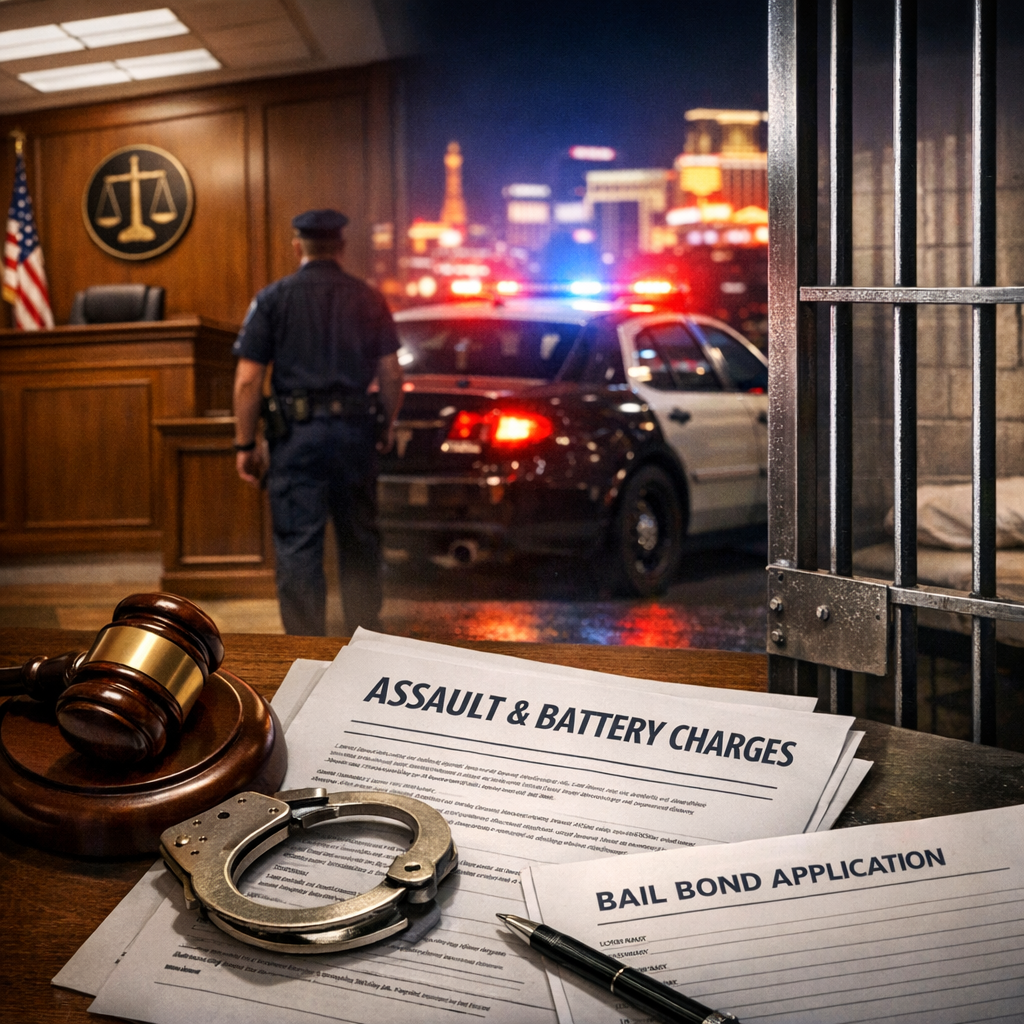
Assault and Battery Arrests in Las Vegas: Bail Bonds, Costs, and What Happens Next

1. Assault and Battery Arrests in Las Vegas: Understanding Your Bail Options
Published: November 18, 2026
Assault and battery arrests in Las Vegas can happen unexpectedly, leaving families scrambling to understand criminal charges, jail procedures, and bail requirements. Whether an arrest occurs after an argument on the Las Vegas Strip, a confrontation at a casino, or a dispute in a residential neighborhood, knowing how the local bail process works can help families respond quickly.
In Nevada, assault and battery are separate criminal offenses. Assault generally involves unlawfully attempting to use physical force against someone or intentionally placing someone in reasonable fear of immediate bodily harm. Battery involves the willful and unlawful use of force or violence against another person. Both offenses can result in arrest, but the charges and potential penalties depend on the circumstances.
After an arrest, the accused may be transported to the Clark County Detention Center or another local correctional facility. Depending on the charges and applicable release procedures, bail may be available through a preset schedule or following a judicial determination.
For families seeking Las Vegas bail bonds, understanding the difference between an arrest, a criminal charge, and a bail decision is important. An arrest does not establish guilt, and posting bail does not resolve the underlying criminal case.
If someone you know has been arrested for assault or battery in Las Vegas, call (702) 450-4000 to discuss available bail bond services and the information needed to begin the process.
2. Nevada Assault and Battery Charges: Why the Details Matter
Not every assault or battery arrest in Nevada involves the same charges or potential consequences. The alleged conduct, relationship between the individuals involved, use of a weapon, and extent of any injuries can affect how prosecutors classify a case.
Under Nevada law, assault is primarily addressed by NRS 200.471, while battery is addressed by NRS 200.481. Certain incidents involving family members, dating partners, or household relationships may also fall under Nevada’s domestic violence statutes, including NRS 200.485.
Common circumstances associated with assault and battery arrests in Las Vegas include:
- Physical altercations at casinos, bars, nightclubs, or entertainment venues.
- Arguments between acquaintances that allegedly involve threats or physical contact.
- Domestic disputes resulting in allegations of battery constituting domestic violence.
- Incidents involving alleged substantial bodily harm.
- Confrontations involving weapons or allegations against protected categories of victims.
Some cases involve misdemeanor allegations, while others may involve felony charges. More serious allegations can affect the court’s release decision, the amount of bail, and any conditions imposed before trial.
For example, an allegation involving a deadly weapon may be treated differently from a simple battery accusation without substantial bodily harm. Domestic violence allegations can also trigger additional arrest and release restrictions under Nevada law.
A bail bond agent cannot determine guilt, dismiss charges, or predict the outcome of a criminal case. However, an agent can help families understand the administrative steps involved in arranging a bond once the court or applicable legal process authorizes release.
3. What Happens Next After an Assault or Battery Arrest in Las Vegas?
The hours immediately following an arrest are often the most confusing for families. Understanding the typical sequence can make it easier to locate someone in custody and prepare for possible release.
Although procedures vary depending on the arresting agency and charges, the process commonly includes these steps:
- Arrest and transportation: Officers take the arrested person to an appropriate detention or booking facility.
- Booking: Jail personnel record identifying information, process fingerprints, document allegations, and complete required intake procedures.
- Custody information: Once booking information becomes available, family members may be able to locate the person through the relevant detention facility’s inmate search system.
- Bail or release determination: Release eligibility may depend on Nevada law, the charges, an applicable bail schedule, and judicial decisions.
- Bond arrangements: When a bond is permitted, a licensed bail bond agent may help arrange the required surety bond.
- Release processing: After the necessary paperwork is accepted, detention personnel complete their internal release procedures.
- Future court appearances: The defendant must comply with all court dates and release conditions while the case remains pending.
For many Las Vegas arrests, the Clark County Detention Center is an important starting point. However, an individual may instead be held at a municipal jail or another correctional facility, depending on the arrest location and responsible agency.
Families should understand that release is not instantaneous. Booking delays, court schedules, verification requirements, and jail staffing can affect timing.
In cases involving domestic violence allegations, statutory restrictions may prevent release during an initial holding period, even when bail arrangements are otherwise available. A bail bond company cannot override these legal requirements.
To discuss the next administrative steps after an arrest, contact (702) 450-4000.
4. How Las Vegas Bail Bonds Work for Assault and Battery Cases
When a court or authorized release procedure permits a surety bond, a licensed Las Vegas bail bond company may help secure the defendant’s release without requiring the family to deposit the entire bail amount directly with the court.
A bail bond is a financial guarantee that the defendant will appear as required. The bail bond company provides the bond, while the person arranging it generally pays a regulated premium and may have additional contractual obligations.
For example, if bail is set at $10,000, the family may be able to obtain a surety bond by paying the applicable premium rather than depositing the full $10,000 in cash. Using a hypothetical 15% premium, that would equal $1,500. The actual premium and any permitted charges must comply with Nevada law and applicable regulatory requirements.
The amount of bail is not determined by the bail bond agent. Courts and authorized release procedures establish bail or other release conditions based on applicable legal standards.
Depending on the bond agreement, the company may request identification, employment details, contact information, or collateral. A co-signer may also be required to accept financial responsibilities connected to the defendant’s compliance.
Before signing, customers should review the premium, any permitted fees, collateral provisions, and circumstances that could create additional liability.
Posting a bond does not eliminate criminal charges or guarantee unrestricted freedom. Courts may impose conditions involving travel, contact with alleged victims, supervision, or other requirements.
Families searching for affordable assault and battery bail bonds in Las Vegas should prioritize licensed providers that explain costs clearly and provide written documentation before completing a transaction.
5. Bail Costs, Release Conditions, and Nevada Legal Compliance
Nevada has specific laws governing both bail bond businesses and the release of people accused of crimes. Two important statutory references are NRS Chapter 697 and NRS Chapter 178.
NRS Chapter 697 regulates Nevada bail agents and bail enforcement agents. It addresses matters such as licensing, professional responsibilities, and the legal framework governing bail bond transactions. In practical terms, this means a bail bond provider must operate under state rules rather than inventing its own unrestricted fee structure or business practices.
NRS Chapter 178 includes criminal procedure rules concerning bail, release, and related court processes. Its provisions help establish how courts address pretrial release and the conditions associated with allowing an accused person to remain outside custody while criminal proceedings continue.
These laws serve different purposes. NRS 697 primarily concerns the professionals and businesses involved in bail transactions, while NRS 178 addresses important aspects of the criminal release process.
Other Nevada statutes may also apply. For example, allegations involving battery constituting domestic violence can trigger additional restrictions, including circumstances covered by NRS 178.484.
Bail amounts and release conditions are not automatically identical for everyone charged with assault or battery. Courts may consider legally relevant circumstances, including the seriousness of the allegations, public safety concerns, and the likelihood of future court appearances.
Families should also recognize that a bond premium is generally payment for the bonding service, not a refundable deposit simply because the defendant later appears in court.
This information is provided for general educational purposes and is not legal advice. Criminal defense questions, challenges to bail conditions, and case-specific legal decisions should be discussed with a qualified Nevada attorney.
6. Finding Reliable Assault and Battery Bail Bonds in Downtown Las Vegas
When someone is in custody, choosing a dependable bail bond provider matters. Families often face urgent decisions while trying to understand unfamiliar paperwork, financial commitments, and detention procedures.
Local accessibility can make communication easier, particularly when relatives need to discuss payment arrangements, provide identification, or review bond documents.
For assistance with Las Vegas bail bond inquiries, the local contact address is 629 S Casino Center Blvd, Las Vegas, NV 89101, with telephone assistance available at (702) 450-4000.
This downtown Las Vegas location provides a convenient geographic reference for families dealing with arrests connected to the Las Vegas Strip, downtown entertainment district, and surrounding Clark County communities. Contact the office before visiting to confirm current availability, office hours, and whether in-person documentation is necessary.
When evaluating a bail bond company, consider the following practical questions:
- Is the bail agent properly licensed to conduct business in Nevada?
- Will the company explain the premium and any additional permitted charges?
- Are payment obligations and collateral requirements provided in writing?
- Can the agent explain the paperwork needed to begin a bond transaction?
- Does the company clearly distinguish bail processing from criminal legal representation?
- Will the agent explain what happens if the defendant misses a required court appearance?
A reputable provider should avoid promising a specific release time, guaranteed bond approval, or a particular criminal case outcome.
Even after a bond is posted, actual release depends on jail processing and any outstanding holds or legal restrictions.
Clear communication is especially important for families dealing with assault and battery arrests in Las Vegas because the charges may involve additional court conditions or restrictions on contact with another person.
7. Need an Assault or Battery Bail Bond in Las Vegas? Call (702) 450-4000
An assault or battery arrest can quickly disrupt employment, childcare, travel plans, and family responsibilities. Visitors arrested while vacationing in Las Vegas may face additional complications because they live outside Nevada and must still comply with court requirements.
The most useful immediate step is to gather accurate information before beginning the bail bond process. If possible, obtain the arrested person’s full legal name, date of birth, booking number, detention location, and known charges.
If bail has already been established, ask about the amount and whether any restrictions prevent immediate release. If bail has not been determined, an agent may be able to explain what information is needed once the applicable release decision becomes available.
Someone considering becoming a co-signer should carefully review the bond agreement. Co-signing can create enforceable financial responsibilities, and obligations may continue while the criminal case remains pending.
After release, the defendant must follow court instructions, attend required hearings, and comply with any restrictions imposed by the judge. Missing court can result in serious consequences, including bond forfeiture and renewed custody.
For families navigating assault and battery arrests in Las Vegas, timely communication and accurate paperwork can help prevent avoidable administrative delays. However, no bail bond company can guarantee release when a legal hold, judicial restriction, or other barrier applies.
Call (702) 450-4000 to discuss Las Vegas assault and battery bail bond services, available payment arrangements, and the information required to get started.
Local contact address: 629 S Casino Center Blvd, Las Vegas, NV 89101.
Whether the arrest involves a misdemeanor battery allegation, a more serious assault charge, or a case requiring judicial review, understanding the process is the first step toward making informed decisions. Contact the office for assistance with bond-related questions, and consult a Nevada criminal defense attorney for advice concerning the charges or court proceedings.
Frequently Asked Questions
- Can you get bail for an assault or battery arrest in Las Vegas?
- Bail may be available for many assault and battery arrests in Las Vegas, but eligibility depends on the charges, applicable Nevada law, and the court’s release decision. Some cases involve additional restrictions, particularly when domestic violence allegations, serious injuries, or other aggravating circumstances are involved. A licensed bail bond agent can discuss bond arrangements once release has been authorized.
- How much does a bail bond cost for assault or battery in Las Vegas?
- The cost depends on the bail amount and the premium permitted under Nevada’s applicable bail bond regulations. For illustration, a $10,000 bond at a hypothetical 15% premium would cost $1,500. Actual rates, permitted charges, and collateral requirements should be confirmed with the licensed bail agent before signing an agreement. Call (702) 450-4000 to discuss the circumstances of a specific bond inquiry.
- How long does it take to get someone out of jail after a battery arrest?
- Release times vary depending on booking completion, bail eligibility, court availability, outstanding holds, and detention facility processing. Some individuals may become eligible for release after routine processing, while others must wait for a judicial decision or statutory holding period. Posting a bond does not guarantee immediate release.
- What is the difference between assault and battery under Nevada law?
- Under NRS 200.471, assault generally involves unlawfully attempting to use physical force against another person or intentionally placing someone in reasonable apprehension of immediate bodily harm. Under NRS 200.481, battery generally involves the willful and unlawful use of force or violence against another person. The classification and potential penalties depend on the specific circumstances and applicable statutes.
- Can someone be released on bail after a domestic violence battery arrest in Las Vegas?
- Release may be possible, but Nevada law imposes special requirements in certain domestic violence cases. NRS 178.484 includes provisions affecting release after arrests involving battery constituting domestic violence. An applicable holding period, judicial determination, or other legal restriction may delay release. A bail bond agent cannot bypass these requirements.
- Where are people taken after assault and battery arrests in Las Vegas?
- Many people arrested in the Las Vegas area are processed through the Clark County Detention Center, although the actual facility depends on the arresting agency, jurisdiction, and circumstances. Some individuals may be held at municipal detention facilities or other correctional locations. Confirming the detention facility and booking information is an important first step before arranging a bond.
- Can a family member or friend pay for an assault and battery bail bond?
- Yes. A family member, friend, or another eligible person may be able to arrange payment for a bail bond and act as a co-signer if the bonding company accepts the arrangement. Co-signers should carefully review all financial obligations, collateral provisions, and potential consequences if the defendant fails to comply with bond requirements. The premium and contractual terms should be explained before payment.
- Who can I call for assault and battery bail bonds in Las Vegas?
- For Las Vegas assault and battery bail bond inquiries, call (702) 450-4000. The local contact address is 629 S Casino Center Blvd, Las Vegas, NV 89101. Have the arrested person’s full name, date of birth, detention location, and booking information available if possible. Contact the office before visiting to confirm availability and the documents needed. Bond services do not replace legal representation from a qualified Nevada criminal defense attorney.
Need immediate help in Las Vegas? Contact us at (702) 450-4000 or call our office at 629 S Casino Center Blvd, Las Vegas, NV 89101.